Lamar Valley - Predators and Prey
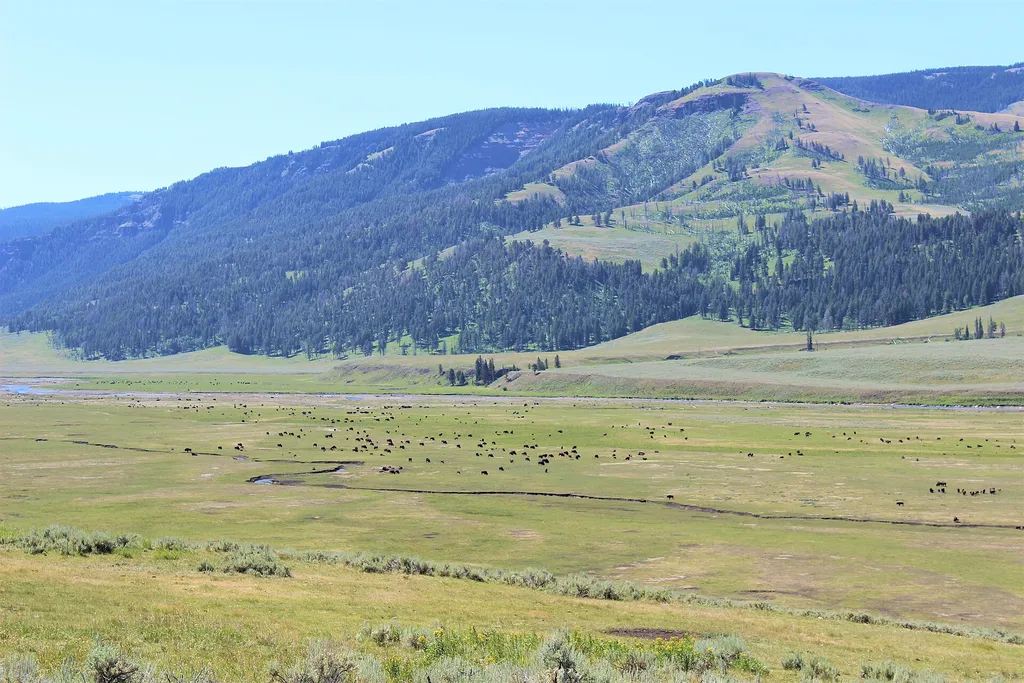 Photo: Aaron Zhu — Wikimedia Commons (CC BY-SA 3.0)
- May–Sep
- best months
Is Lamar Valley - Predators and Prey open right now?
Closure in the area
There's a closure order in Yellowstone National Park. It doesn't name Lamar Valley - Predators and Prey, so check the source for the area it covers (2 listed).
Most Park Roads Closed to All Vehicles
Park closure covering Yellowstone National Park · NPS · Yellowstone National Park
Biscuit Basin Closed Due to Hydrothermal Explosion
Park closure covering Yellowstone National Park · NPS · Yellowstone National Park
As of · Source: NPS · Yellowstone National Park. Agencies don't list every closure — check before you go.
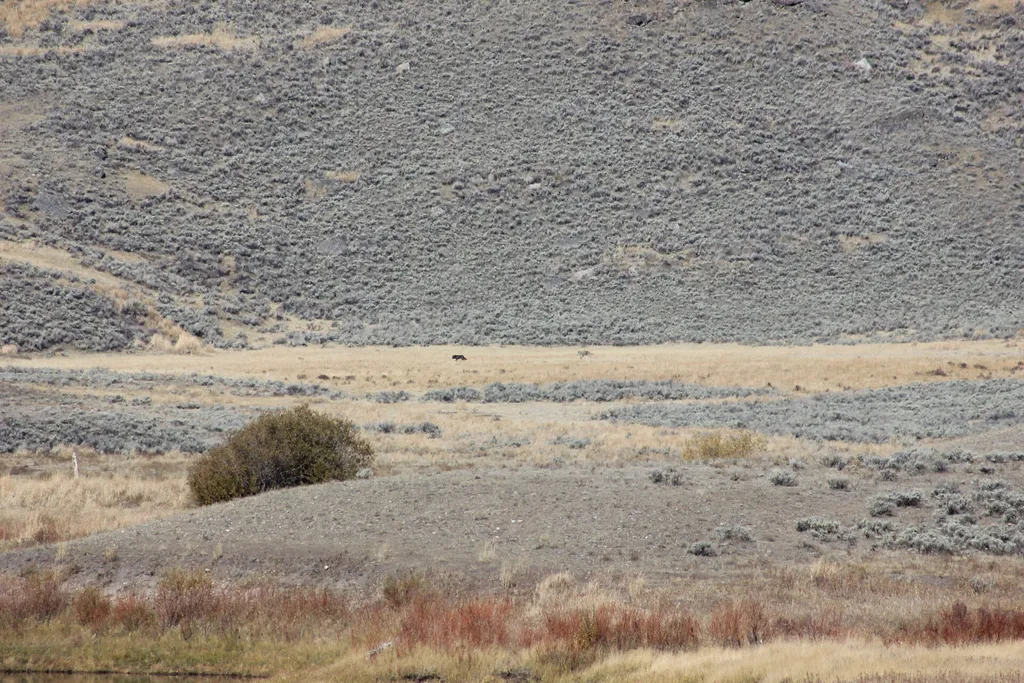
Wolves eat a wide variety of prey, large and small. They efficiently hunt large prey that other predators cannot usually kill. In Yellowstone, 90% of their winter prey is elk. In the summer, 10 to 15% of their summer prey is deer. They also can kill bison. Many other animals benefit from wolf kills. For example, when wolves kill an elk, ravens arrive almost immediately. Coyotes arrive soon after, waiting nearby until the wolves are satisfied. Bears will attempt to chase the wolves away, and are usually successful. Many other animals consume the remains, from magpies to invertebrates. The northern range of Yellowstone is one of the best places in the world to watch wolves. Animals are Dangerous Do not approach or feed any animal. Bison and elk have injured people. Stay 100 yards (91 m) from bears and wolves. Stay 25 yards (23 m) from all other animals. You are responsible for your safety. Think Safety, Act Safely. Yellowstone is a Dangerous Place.
- Lamar Valley - Trophic CascadesHiking2.9 mi
- Buffalo Fork TrailHiking3.3 mi
 Lamar River BridgeHikingPhoto: runt35 — Wikimedia Commons (CC BY 3.0)3.5 mi
 Lamar Valley at Crystal CreekHikingPhoto: Greg Willis from Denver, CO, usa, CC BY-SA 2.0 (via Wikimedia Commons)3.8 mi
- 2S1 Campsite Spur TrailHiking3.8 mi
- Soldier's TrailHiking3.9 mi
 Lamar River Stock Cutoff TrailHikingPhoto: Greg Willis from Denver, CO, usa, CC BY-SA 2.0 (via Wikimedia Commons)4.7 mi
- Cache CreekCanoeing9.8 mi
Source: Roamze catalog (indexable pages within 10 miles, PostGIS distance)
- Lamar River BridgeHiking · ~6 min drive
- Lamar River Stock Cutoff TrailHiking · ~8 min drivePhoto: Greg Willis from Denver, CO, usa, CC BY-SA 2.0 (via Wikimedia Commons)
- Specimen Ridge TrailHiking · ~8 min drivePhoto: Greg Willis from Denver, CO, usa, CC BY-SA 2.0 (via Wikimedia Commons)
 Yellowstone River Overlook TrailHiking · ~11 min drivePhoto: Greg Willis from Denver, CO, usa, CC BY-SA 2.0 (via Wikimedia Commons)
 Pebble Creek TrailHiking · ~12 min drivePhoto: Greg Willis from Denver, CO, usa, CC BY-SA 2.0 (via Wikimedia Commons)
- Lamar Valley at Crystal CreekHiking · ~6 min drivePhoto: Greg Willis from Denver, CO, usa, CC BY-SA 2.0 (via Wikimedia Commons)
- Trout Lake TrailheadHiking · ~11 min drive
- Slough Creek TrailHiking · ~10 min drive
 Tower Creek TrailHiking · ~12 min drivePhoto: cchadek, CC BY 3.0 (via Wikimedia Commons)
 Thunderer Cutoff TrailHiking · ~13 min drivePhoto: Greg Willis, CC BY-SA 3.0 (via Wikimedia Commons)
Also worth it near here
 Druid PeakSummit · ~6 min drivePhoto: Mike Cline, Public domain (via Wikimedia Commons)
 Slough Creek CampgroundCamping · ~7 min drivePhoto: Yellowstone National Park from Yellowstone NP, USA, Public domain (via Wikimedia Commons)
 Tower FallWaterfall · ~12 min drivePhoto: Daniel Mayer, CC BY-SA 3.0 (via Wikimedia Commons)
- Barronette Ski TrailSki touring · ~15 min drive
Best time to visit Lamar Valley - Predators and Prey
Best months: May–September. Best months have typical highs of 55–85 °F, lows of 30 °F or warmer (32 °F where the station doesn't record snow), at most one snowy day and no more than 12 wet days.
Jan
27° / 1°
Feb
31° / 5°
Mar
40° / 13°
Apr
50° / 24°
May
60° / 32°
Jun
69° / 37°
Jul
82° / 41°
Aug
80° / 39°
Sep
71° / 33°
Oct
54° / 26°
Nov
37° / 13°
Dec
27° / 3°
Typical high / low (°F) and days with rain or snow, 1991–2020. Measured at Lamar Rs, WY, 1.2 mi away at 6,575 ft. This station doesn't record snowfall. Source: NOAA NCEI U.S. Climate Normals 1991–2020.
