Senoj Lake
- 0.8 mi
- round trip
- 264 ft
- climb
- 5,618 ft
- high point
- Out and back
- route
- May–Sep
- best months
Is SENOJ LAKE open right now?
Closure in the area
There's a closure order in Deschutes National Forest. It doesn't name SENOJ LAKE, so check the source for the area it covers (3 listed).
West Bend Area Trail Closures
Agency closure covering Deschutes National Forest · USFS · Deschutes National Forest
West Bend IRSC- Area, Road and Trail Closure
Agency closure covering Bend/Fort Rock Ranger District · Order 06-01-01-26-03 · USFS · Bend/Fort Rock Ranger District
Cabin Butte Area Closure
Agency closure covering Bend/Fort Rock Ranger District · Order 06-01-01-26-01 · USFS · Bend/Fort Rock Ranger District
Camping & Campfire Restrictions Forest Order
Agency alert covering Deschutes National Forest · Order 06-01-26-01 · USFS · Deschutes National Forest
Cave Resource Protection Forest Order
Agency alert covering Deschutes National Forest · Order 06-01-26-02 · USFS · Deschutes National Forest
As of · Source: USFS · Deschutes National Forest. Agencies don't list every closure — check before you go.
Senoj Lake is an easy out-and-back hike of about 1.6 miles in Oregon's Three Sisters Wilderness, within the Bend/Fort Rock Ranger District of Deschutes National Forest. The trail rises steadily from a starting point near 5,580 feet to a high of about 5,618 feet, with a total gain of 264 feet and the steepest stretch around 0.6 miles in. The most comfortable time to go is summer. July typically brings highs near 83°F and only about three wet days, while September cools to around 75°F with even fewer wet days. Those are typical averages from a nearby weather station at Wickiup Dam, which sits roughly 1,200 feet lower than the trail, so temperatures on the summit run cooler. The hike takes about half a day. The Senoj Lake Trail #14.1 starts just 0.1 mile away. Six Lakes and Red Hill are both within about 3 miles. Little Fawn Campground is about 3.1 miles off for an overnight stay.
Local outfitters
- Horse Creek Lodge & Outfitters22 mi away
- Patio RV Park23 mi away
Not on Roamze yet. Their page has how to reach them.
- Senoj Lake Trail #14.1Hiking0.1 mi
 Six LakesHikingPhoto: David Doan, CC BY-SA 3.0 (via Wikimedia Commons)2.4 mi
- Red HillHiking2.7 mi
- PointCamping2.7 mi
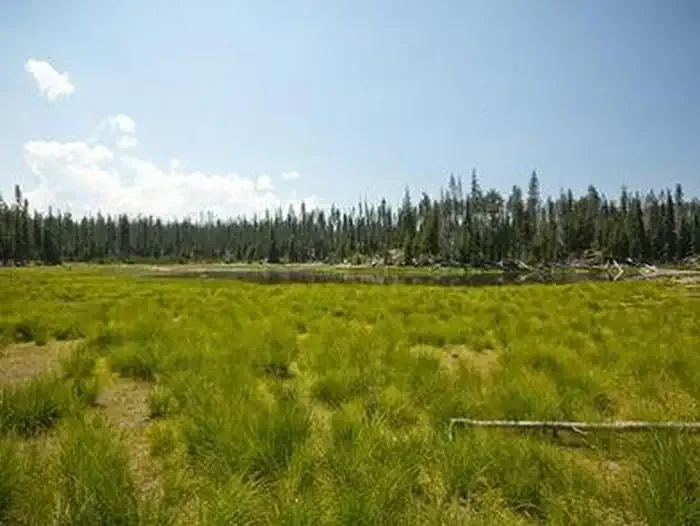 Little Fawn CampgroundCampingPhoto: Recreation.gov (RIDB) / public domain3.1 mi
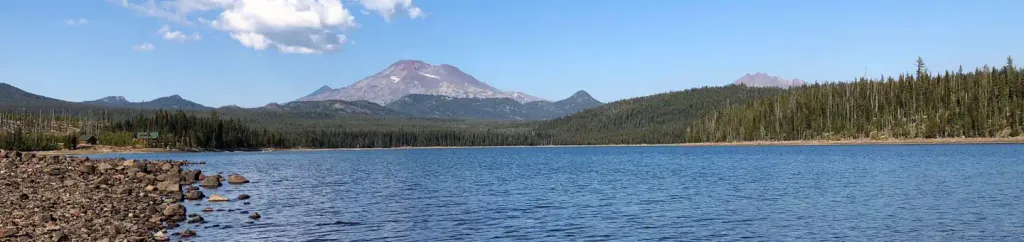 Elk Lake CampgroundCampingPhoto: Recreation.gov (RIDB) / public domain3.4 mi
- Hosmer LakeLake fishing3.9 mi
- Elk CreekCanoeing7.3 mi
Source: Roamze catalog (indexable pages within 10 miles, PostGIS distance)
- Six LakesHiking · ~4 min drivePhoto: David Doan, CC BY-SA 3.0 (via Wikimedia Commons)
 Island Meadow TrailHiking · ~5 min drivePhoto: maprik, CC BY 2.0 (via Flickr)
 AppaloosaHiking · ~11 min drivePhoto: Forest Service Pacific Northwest Region, Public Domain Mark (via Flickr)
- Horse Creek Trail #3514Hiking · ~7 min drive
 Katsuk PondHiking · ~8 min drivePhoto: David Doan, CC BY-SA 3.0 (via Wikimedia Commons)
- Horse Lake Trail #2Hiking · ~6 min drivePhoto: maprik, CC BY 2.0 (via Flickr)
- Elk LakeHiking · ~6 min drivePhoto: David Doan, CC BY-SA 3.0 (via Wikimedia Commons)
- Mink LakeHiking · ~6 min drive
- QUINN CREEKHiking · ~8 min drivePhoto: David Doan, CC BY-SA 3.0 (via Wikimedia Commons)
- Quinn CreekHiking · ~7 min drivePhoto: David Doan, CC BY-SA 3.0 (via Wikimedia Commons)
Best time to visit SENOJ LAKE
Best months: May–September. Best months have typical highs of 55–85 °F, lows of 30 °F or warmer (32 °F where the station doesn't record snow), at most one snowy day and no more than 12 wet days.
Jan
40° / 21°
13 wet
Feb
43° / 22°
11 wet
Mar
48° / 26°
12 wet
Apr
54° / 30°
10 wet
May
63° / 36°
9 wet
Jun
71° / 42°
6 wet
Jul
83° / 47°
3 wet
Aug
82° / 46°
3 wet
Sep
75° / 38°
4 wet
Oct
62° / 31°
8 wet
Nov
46° / 26°
11 wet
Dec
38° / 21°
13 wet
Typical high / low (°F) and days with rain or snow, 1991–2020. Measured at Wickiup Dam, OR, 19.7 mi away at 4,358 ft. The station sits about 1,300 ft lower than this place, so expect it a little cooler here. This station doesn't record snowfall. Source: NOAA NCEI U.S. Climate Normals 1991–2020.

