Site 47 - Juniper Basin Group Campsite
Campground
Campground · 1.6 mi from the trail
No closures listed
The National Park Service lists no closures for Arches National Park.
As of · Source: NPS · Arches National Park. Agencies don't list every closure — check before you go.
Box Arch is a natural arch in Arches National Park in Utah, managed by the National Park Service. It sits at about 4,926 feet, and the nearest town is Castle Valley, roughly 13 miles away. Spring and fall are the most comfortable times to visit. Typical averages from a nearby weather station show May highs around 78°F and October highs around 68°F, while July averages climb to about 96°F. Several trails start close by. The Fiery Furnace Loop is about half a mile away, and the Sand Dune Arch Trail and Broken Arch Connector are each about a mile off. For an overnight stay, Devils Garden Campground is roughly 2 miles away.
Site 47 - Juniper Basin Group Campsite
Campground
 If it rainsCarter Pape, CC BY-SA 4.0 · Wikimedia Commons
Hell's Revenge
Attraction
Places © OpenStreetMap contributors, Places © Overture Maps Foundation · Photos: Carter Pape, CC BY-SA 4.0 (commons)
More in MoabElevation from USGS 3D Elevation Program terrain data (about 10 m resolution).
 Fiery Furnace LoopHikingPhoto: Greg Willis from Denver, CO, usa, CC BY-SA 2.0 (via Wikimedia Commons)0.6 mi
 Broken Arch ConnectorHikingPhoto: Sandy Horvath-Dori from Grand Junction, CO, USA, CC BY 2.0 (via Wikimedia Commons)1 mi
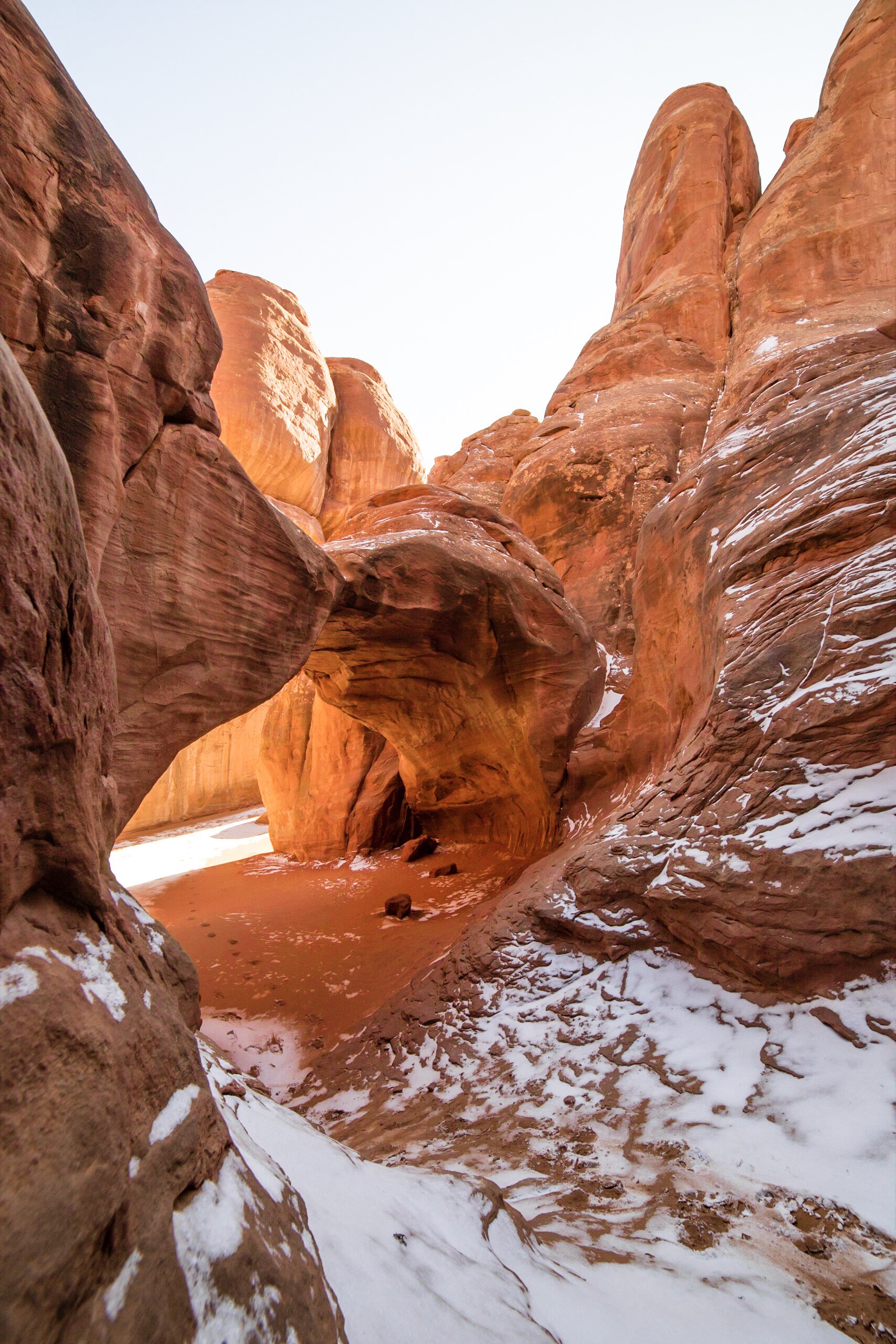 Sand Dune Arch TrailHikingPhoto: NPS/Kayla Vogt1 mi
 Arches National ParkRock climbingPhoto: inkknife_2000 (7.5 million views +), CC BY-SA 2.0 (via Wikimedia Commons)5.1 mi
 The Marching MenRock climbingPhoto: James St. John, CC BY 2.0 (via Wikimedia Commons)6.3 mi
 The StageRock climbingPhoto: Ken Lund from Reno, Nevada, USA, CC BY-SA 2.0 (via Wikimedia Commons)7.4 mi
Source: Roamze catalog (indexable pages within 10 miles, PostGIS distance)
 Broken ArchNatural arch · ~2 min drivePhoto: SBirdsell, CC BY-SA 4.0 (via Wikimedia Commons)
 Tapestry ArchNatural arch · ~3 min drivePhoto: Chris Wonderly, Public domain (via Wikimedia Commons)
 Skyline ArchNatural arch · ~3 min drivePhoto: Thomas Wolf, www.foto-tw.de, CC BY-SA 3.0 (via Wikimedia Commons)
 Landscape ArchNatural arch · ~5 min drivePhoto: Thomas Wolf, www.foto-tw.de, CC BY-SA 3.0 (via Wikimedia Commons)
 Black Cave ArchNatural arch · ~7 min drivePhoto: The Dye Clan, CC BY-SA 3.0 (via Wikimedia Commons)
 Delicate ArchNatural arch · ~7 min drivePhoto: W. Bulach, CC BY-SA 4.0 (via Wikimedia Commons)
 North WindowNatural arch · ~9 min drivePhoto: W. Bulach, CC BY-SA 4.0 (via Wikimedia Commons)
 Turret ArchNatural arch · ~9 min drivePhoto: W. Bulach, CC BY-SA 4.0 (via Wikimedia Commons)
 South WindowNatural arch · ~9 min drivePhoto: KimonBerlin, CC BY-SA 2.0 (via Wikimedia Commons)
Also worth it near here
Fiery Furnace LoopHiking · ~1 min drivePhoto: Greg Willis from Denver, CO, usa, CC BY-SA 2.0 (via Wikimedia Commons) Elephant ButteSummit · ~7 min drivePhoto: Ron Clausen, CC BY-SA 4.0 (via Wikimedia Commons)
Best months: March–May and September–October. Best months have typical highs of 55–85 °F, lows of 30 °F or warmer (32 °F where the station doesn't record snow), at most one snowy day and no more than 12 wet days.
Jan
39° / 17°
5 wet
Feb
47° / 25°
5 wet
Mar
59° / 32°
4 wet
Apr
67° / 39°
4 wet
May
78° / 48°
4 wet
Jun
90° / 58°
3 wet
Jul
96° / 66°
4 wet
Aug
92° / 63°
5 wet
Sep
83° / 53°
5 wet
Oct
68° / 40°
5 wet
Nov
52° / 27°
4 wet
Dec
39° / 17°
5 wet
Typical high / low (°F) and days with rain or snow, 1991–2020. Measured at Moab Canyonland Ap, UT, 9.8 mi away at 4,561 ft. This station doesn't record snowfall. Source: NOAA NCEI U.S. Climate Normals 1991–2020.
