Harriman State Park
- State Park and Recreation
- managed by
- May–Sep
- best months
Is Harriman State Park open right now?
No closures listed
The Forest Service lists no closures for Caribou-Targhee National Forest.
As of · Source: USFS · Caribou-Targhee National Forest. Agencies don't list every closure — check before you go.
Harriman State Park is a state park in Idaho, managed by State Park and Recreation, and it sits within the Ashton/Island Park Ranger District of the Caribou-Targhee National Forest. The nearest town is Island Park, about 14.5 miles away. Summer is the most comfortable time to visit. Typical averages from a nearby weather station in Island Park show July and August highs around 77°F with lows in the low 40s, while winter highs stay in the mid-20s. The West End Loop hike is about 2.5 miles away, and the Ridge Trail is about 5.3 miles off. For an overnight stay, Buttermilk campground is about 7.3 miles away, and Island Park Reservoir offers lake fishing about 8.5 miles from the park.
Park size
11,236 acres
- WEST END LOOPHiking2.5 mi
- Sheridan CreekCanoeing4.6 mi
- Ridge TrailHiking5.3 mi
- Ridge Trail ShortcutHiking5.4 mi
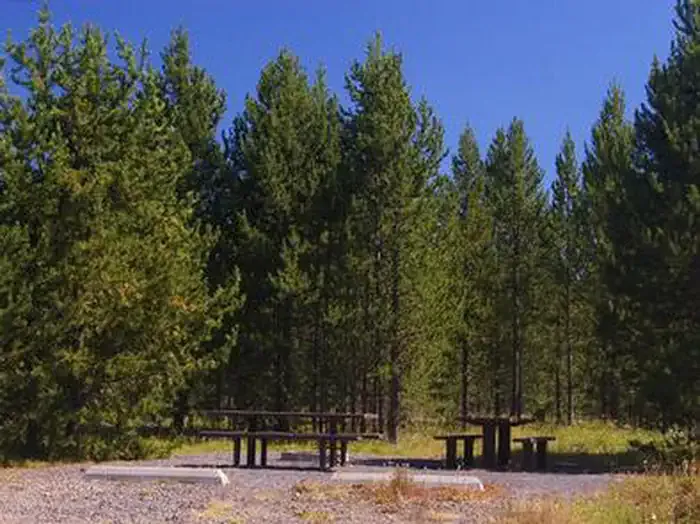 ButtermilkCampingPhoto: Recreation.gov (RIDB) / public domain7.3 mi
- Box Canyon CampgroundCamping8.4 mi
- Island Park ReservoirLake fishing8.5 mi
- Henrys ForkRiver fishing8.6 mi
Source: Roamze catalog (indexable pages within 10 miles, PostGIS distance)
Best time to visit Harriman State Park
Best months: May–September. Best months have typical highs of 55–85 °F, lows of 30 °F or warmer (32 °F where the station doesn't record snow), at most one snowy day and no more than 12 wet days.
Jan
27° / 6°
Feb
30° / 7°
Mar
39° / 14°
Apr
47° / 23°
May
59° / 32°
Jun
67° / 38°
Jul
77° / 43°
Aug
77° / 40°
Sep
68° / 32°
Oct
51° / 24°
Nov
36° / 14°
Dec
25° / 6°
Typical high / low (°F) and days with rain or snow, 1991–2020. Measured at Island Park, ID, 9.8 mi away at 6,290 ft. We don't have this place's elevation, so higher spots nearby can run cooler. This station doesn't record snowfall. Source: NOAA NCEI U.S. Climate Normals 1991–2020.

