George Bagby State Park
- State Department of Natural Resources
- managed by
- Oct–May
- best months
George Bagby State Park is a 735-acre state park in Georgia, about 3.3 miles from the town of Fort Gaines. The State Department of Natural Resources manages the land, and the park holds one fishing or paddling spot within its boundaries. Spring and fall are the most comfortable times to visit. Typical averages from a nearby weather station in Fort Gaines show April highs around 76°F and October highs around 78°F, while July highs reach about 91°F. George T. Bagby State Park, a lake fishing spot, lies about 1.5 miles away. Cotton Hill Nature Trail is about 1.6 miles off, and Cotton Hill campground is about 1.9 miles away. Paddlers can also head to Cemochechobee Creek, roughly 5 miles from the park.
Park size
735 acres
Inside this park
- George T. Bagby State ParkLake fishing1.5 mi
- Cotton Hill Nature TrailHiking1.6 mi
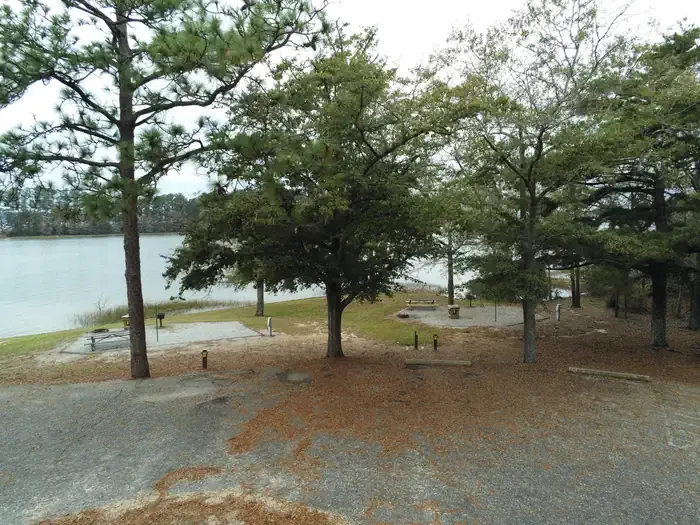 Cotton HillCampingPhoto: Recreation.gov (RIDB) / public domain1.9 mi
- Cemochechobee CreekCanoeing5.1 mi
Source: Roamze catalog (indexable pages within 10 miles, PostGIS distance)
 Kolomoki Mounds State ParkState park · ~26 min drivePhoto: Tony.freeman at English Wikipedia, CC BY-SA 3.0 (via Wikimedia Commons)
 Florence Marina State ParkState park · ~50 min drivePhoto: Thomsonmg2000, CC0 (via Wikimedia Commons)
- Lakepoint Resort State ParkState park · ~38 min drive
- Blue Springs State ParkState park · ~48 min drive
- Providence Canyon Outdoor Recreation AreaState park · ~48 min drive
Best time to visit George Bagby State Park
Best months: October–May. Best months have typical highs of 55–85 °F, lows of 30 °F or warmer (32 °F where the station doesn't record snow), at most one snowy day and no more than 12 wet days.
Jan
59° / 38°
Feb
62° / 40°
Mar
69° / 45°
Apr
76° / 52°
May
84° / 62°
Jun
89° / 69°
Jul
91° / 72°
Aug
90° / 72°
Sep
87° / 67°
Oct
78° / 56°
Nov
69° / 46°
Dec
62° / 41°
Typical high / low (°F) and days with rain or snow, 1991–2020. Measured at Ft Gaines 2, GA, 3.8 mi away at 210 ft. We don't have this place's elevation, so higher spots nearby can run cooler. This station doesn't record snowfall. Source: NOAA NCEI U.S. Climate Normals 1991–2020.

