Trail of Time: Headquarters Portal (Parking Lot A)
 Photo: beglib, CC BY-SA 3.0 (via Wikimedia Commons)
- Apr–Oct
- best months
Is Trail of Time: Headquarters Portal (Parking Lot A) open right now?
Closure in the area
There's a closure order in Grand Canyon National Park. It doesn't name Trail of Time: Headquarters Portal (Parking Lot A), so check the source for the area it covers.
INNER CANYON TRAIL CLOSURES
Park closure covering Grand Canyon National Park · NPS · Grand Canyon National Park
Overnight Lodging Suspended and Parkwide Stage 4 Water Restrictions
Park alert covering Grand Canyon National Park · NPS · Grand Canyon National Park
INNER CANYON WATER SHUTOFFS
Park alert covering Grand Canyon National Park · NPS · Grand Canyon National Park
Critical Backcountry Updates/Closures
Park alert covering Grand Canyon National Park · NPS · Grand Canyon National Park
As of · Source: NPS · Grand Canyon National Park. Agencies don't list every closure — check before you go.
To get to this portal, walk the spur trail near Park Headquarters and parking lot A. It is a 0.4 mile (0.65 km) to the portal at the junction with the Canyon Rim Trail, (Trail of Time). This portal sits at 1,000 million (1 billion) years ago along the Trail of Time, a period of Grand Canyon history which corresponds with the deposition of rocks belonging to the Grand Canyon Supergroup, some of Grand Canyon's oldest sedimentary rocks. This fact is reflected in the seating rocks and paving stones surrounding the portal. The paving stones represent sandstones of the Dox Formation, while the seating rocks include several large pieces of Hotauta Conglomerate (the basal member of the Bass Formation) and Bass Limestone; one piece of purplish limestone bears striking ripple marks formed by flowing water. On the east side of the actual trail junction sits a large piece of Shinumo Quartzite, with an equally large piece of Sixtymile Conglomerate sitting next to it. Directly opposite these rocks, on the west side of the junction, sit two large stromatolite fossils, the top sides of which have been cut and polished. Walking west from here will take you to exhibits of the oldest rocks in Grand Canyon and Grand Canyon Village. 0.6 mile (0.9 km). Walking east from here will take you through Grand Canyon's younger years to the present day and eventually to Yavapai Geology Museum. 0.7 mile (1.13 km). Trail of Time Overview The Trail of Time is the world's largest geoscience exhibition at one of the world's grandest geologic landscapes, Grand Canyon National Park. The trail utilizes the unique vistas and rocks of Grand Canyon to help visitors ponder, explore, and understand the magnitude of geologic time and the stories encoded by Grand Canyon rocks and landscapes. Geologic time is immensely long. The 4.56 km (2.8 mi) trail is marked every meter, with 1 meter = 1 million years of our 4,560,000,000 year-long Earth history. Viewing tubes, rocks on plinths, and wayside panels help visitors connect the rocks visible in Grand Canyon to their place along the timeline. The main Trail of Time can be entered at different points - including the east end near Yavapai Point (young end), west end at Grand Canyon Village (old end), or a middle point where a connecting trail comes from the Park Headquarters parking area (Parking Lot A). Shuttle stops connect each entry point, so you can walk it in several ways and still get back to your car. The entry portals have messages on each side appropriate for those approaching (welcome) or for those completing different segments of the Trail (congratulations). Located on the South Rim of Grand Canyon National Park, the Trail of Time extends along the paved Rim Trail between the Yavapai Geology Museum on the east and Maricopa Point on the west. The main portion of the Trail between Yavapai Geology Museum and Grand Canyon Village is accessible to wheelchairs and baby strollers, and it is convenient to shuttle bus stops and parking areas in a heavily-visited section of the park.
Local outfitters
- Buck Wild Hummer Tours6 mi away
- Wander Camp22 mi away
Not on Roamze yet. Their page has how to reach them.
 Animal Life Appeared About 630 Million Years AgoHikingPhoto: Hermann Luyken, CC0 (via Wikimedia Commons)0.3 mi
- Headquarters Rim SpurHiking0.3 mi
- Zuni TrailHiking0.4 mi
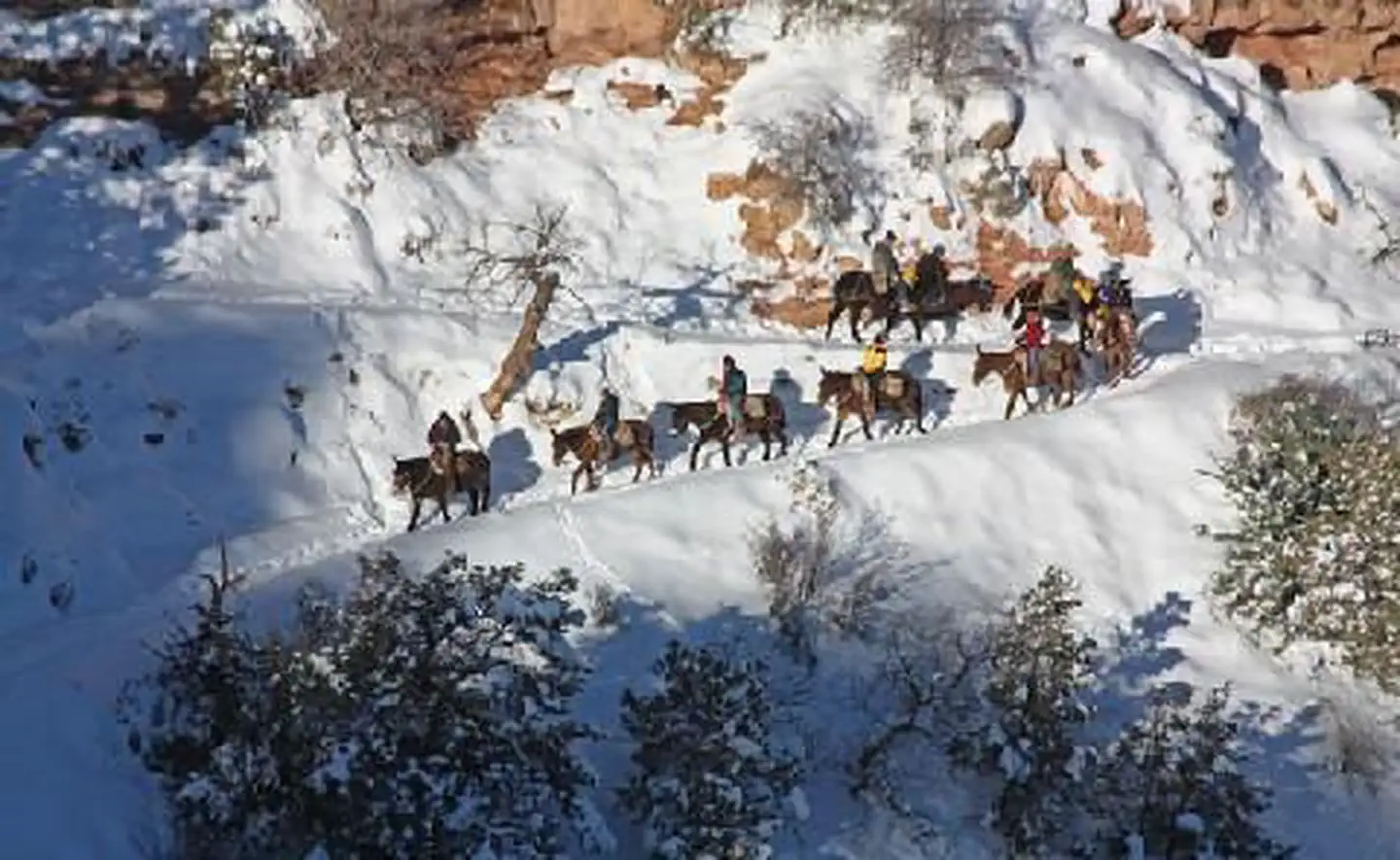 El Tovar HotelLake fishing0.7 mi
 Wailing WallRock climbingPhoto: Hermann Luyken, CC0 (via Wikimedia Commons)1.2 mi
- Bright Angel WallsRock climbingPhoto: Hermann Luyken, CC0 (via Wikimedia Commons)1.2 mi
- Tusayan Ranger DistrictRiver fishing4.8 mi
- Tusayan - MontaneCamping8.4 mi
Source: Roamze catalog (indexable pages within 10 miles, PostGIS distance)
- Animal Life Appeared About 630 Million Years AgoHiking · Next doorPhoto: Hermann Luyken, CC0 (via Wikimedia Commons)
 Headquarters to Geology Museum TrailHiking · ~1 min drivePhoto: Grand Canyon Conservancy, Public Domain Mark (via Flickr)
 Bright Angel TrailHiking · ~3 min drivePhoto: Nate Loper • #ArizonaGuide ️, CC BY 2.0 (via Flickr)
- Long Jim TrailHiking · ~4 min drive
 Grand Canyon's Rocks Are Incredibly OldHiking · Next doorPhoto: Hermann Luyken, CC0 (via Wikimedia Commons)
 Village GreenwayHiking · ~2 min drivePhoto: Capt' Gorgeous, CC BY 2.0 (via Flickr)
- Rim TrailHiking · ~4 min drive
 Trail of Time: Verkamp's Visitor Center PortalHiking · Next doorPhoto: Hermann Luyken, CC0 (via Wikimedia Commons)
 Havasupai Gardens TrailsHiking · ~2 min drivePhoto: Grand Canyon Conservancy, Public Domain Mark (via Flickr)
 Grandeur PointHiking · Next doorPhoto: Hermann Luyken, CC0 (via Wikimedia Commons)
Also worth it near here
Best time to visit Trail of Time: Headquarters Portal (Parking Lot A)
Best months: April–October. Best months have typical highs of 55–85 °F, lows of 30 °F or warmer (32 °F where the station doesn't record snow), at most one snowy day and no more than 12 wet days.
Jan
42° / 26°
Feb
44° / 27°
Mar
52° / 31°
Apr
59° / 36°
May
68° / 44°
Jun
80° / 55°
Jul
84° / 59°
Aug
81° / 58°
Sep
75° / 53°
Oct
63° / 41°
Nov
51° / 33°
Dec
43° / 24°
Typical high / low (°F) and days with rain or snow, 1991–2020. Measured at Grand Canyon Visitor Ctr, AZ, 0.9 mi away at 7,083 ft. This station doesn't record snowfall. Source: NOAA NCEI U.S. Climate Normals 1991–2020.


