Needle Rock
- 2,206 ft
- elevation
- May–Jun, Sep–Oct
- best months
Needle Rock is an arch in southern Oregon, sitting at 2,206 feet about 8 miles from the town of Prospect. It is a single feature rather than a route, so there is no climb to plan around, no trail to measure, and no difficulty to rate. It works as a destination in its own right, a rock formation to visit rather than a way to get from one place to another. Summer is the most comfortable time to go. Typical averages from a nearby weather station show July and August highs around 89°F with only two or three wet days a month, while winter brings highs in the upper 40s and rain on more than half the days. Several trails start close by. Lost Lake Edge Trail is about a mile away, and the Rogue River Trail and Flounce Rock Trails are both within 2 miles. For an overnight stay, Abbott Creek Campground is roughly 6 miles off.
- Elevation
- 2,206 ft
Elevation from USGS 3D Elevation Program terrain data (about 10 m resolution).
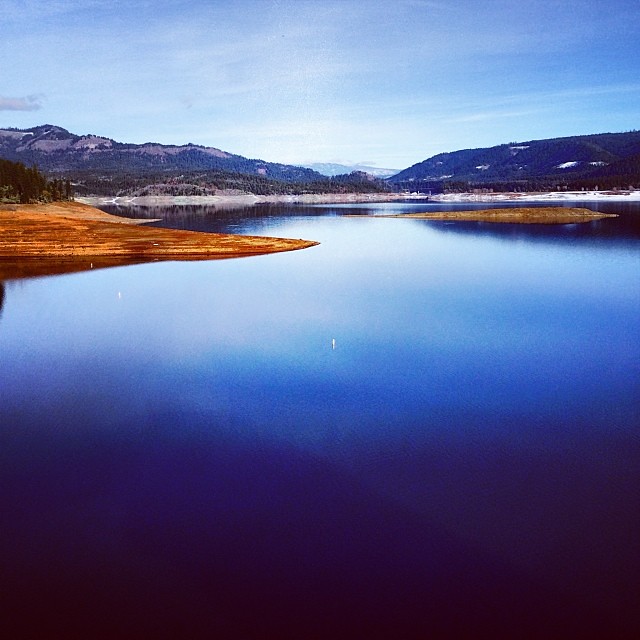 Lost Lake Edge TrailHikingPhoto: Robert Glen Fogarty, CC BY 2.0 (via Flickr)1.2 mi
- Rogue River TrailHiking2 mi
- Flounce Rock TrailsHiking2.2 mi
- Abbott Creek CampgroundCamping5.6 mi
 Elk CreekCanoeingPhoto: Little Mountain 5, CC BY-SA 3.0 (via Wikimedia Commons)7.3 mi
- Beaver Dam CreekCanoeing8.1 mi
- Mill Creek CampgroundCamping9.6 mi
- Sugarpine CreekCanoeing9.7 mi
Source: Roamze catalog (indexable pages within 10 miles, PostGIS distance)
Best time to visit Needle Rock
Best months: May–June and September–October. Best months have typical highs of 55–85 °F, lows of 30 °F or warmer (32 °F where the station doesn't record snow), at most one snowy day and no more than 12 wet days.
Jan
50° / 30°
16 wet
Feb
54° / 31°
14 wet
Mar
58° / 33°
16 wet
Apr
62° / 35°
15 wet
May
71° / 41°
11 wet
Jun
78° / 45°
5 wet
Jul
89° / 50°
3 wet
Aug
89° / 49°
2 wet
Sep
83° / 44°
4 wet
Oct
70° / 38°
9 wet
Nov
55° / 34°
16 wet
Dec
48° / 30°
17 wet
Typical high / low (°F) and days with rain or snow, 1991–2020. Measured at Prospect 2 Sw, OR, 5 mi away at 2,482 ft. This station doesn't record snowfall. Source: NOAA NCEI U.S. Climate Normals 1991–2020.
